


My interests are my castle!
Rafi Blumenfeld: Research plans / main interests
The following list is in constant evolution. The highlighted words will send you to somewhat more detailed decriptions of the approaches that I take / intend to take / would like to take in addressing these problems. This page is updated rather slowly, but it gives a flavour of what I have been doing. Since the list covers a rather broad range of interests progress is limited to current pet problems. I therefore welcome discussions that may either result in collabotaions or get others involved in some of these ideas.
Current interests
- Stress transmission and yield flow in granular media and cellular systems: (In parts with Robin C. Ball and Sir Sam F. Edwards)
This work is relevant to many industries: powders, grain transport, mechanical and flow properties of sand, colloidal suspensions, stress transmission in cellular systems, and much and solid foams and more. It has been recognised that the key to understanding the rich behaviour of granular matter is a fundamental understanding of isostatic states. These are stress states in which the fundamental discrete forces between elements of the system (grains, struts, colloids) are statically determinate. In isostatic states a granular assembly is marginally rigid and we have verified the approachability and relevance of such states experimentally. The significance of isostaticity is that the conventional equations of elasticity theory are redundant for the purpose of determining stresses in such systems and a new theory is required. We have further discovered that the marginal migidity state has characteristics of a critical point, a discovery that has profound effects on the understanding of granular matter in general. We went on to formulate a first-principles isostaticity theory for the mesoscopic equations of stress transmission in two-dimensional systems of rough and smooth grains at such states. The theory represents a shift of paradigm from the principles that govern almost all approaches of the determination of stress fields. Specifically, it decouples the stress field from any deformation-related information, e.g. strain fields. The equations that we found could be coarse-grainable straightforwardly only for a special subset of disordered microstructures. The problem was that generally disordered assemblies of particles exhibit effects similar to frustration in antiferromagnetic systems which hinder coarse-graining by simple volume averaging. This difficulty is now resolved by using an especially desgined coarse-graining procedure.
More recently, the isostaticity equations have been decoupled into equations for the individual components of the stress tensor. This made it possible to derive general solutions for the stress field in macroscopic systems, as well as for the Green function in infinite media. The solution has been found to be non-uniform with arches and force chains developing everywhere, indeed in stark contrast to conventional elasticity theory (see below).
With the insight gained from our theoretical and experimental results we have proposed a first-principles set of equations for the way that granular matter yields and flows under an increasing load. All this work is carried out both theoretically [1], [2], [3], [4], and experimentally.
As is sometimes the case when fundamental science is involved paradigms are shifted. The project has started to branch out in several exciting directions and the flood of new results far exceeds the rate of paper production. I have found a way to map between granular assemblies at the marginal rigidity state and skeletal cellular systems ( Selected by the IOP as one of their three papers of the week 27/2/03 for "novelty, significance and potential impact on future research" ). This mapping makes the theory for stress transmission, as well as a recent entropic analysis, applicable to cellular systems. This suggests that the conventional analysis of the micromechanics of many cellular solids should be at least revisited, if not revised. The work on structurally irregular cellular systems is of relevance in many fields of research, as well as for a wide range of technological applications. In particular it makes it possible to model metal, plastic and biomimetic foams, materials that are central in many technological applications.
Interestingly, the new formalism also holds much promises for a major advance in the field of transport properties of porous media (see below).
Selected milestones:
- 3D missing equations - Derivation of the missing constitutive equations for the stress field for three dimensional quadrivalent open-cell systems, a mapping between this and three dimensional granular assemblies at the marginal rigidity state and therefore the equation applies to the latter msterials as well. This paper is in preparation. (Dec02)
- Coarse-graining - Coarse-graining of the Ball-Blumenfeld constitutive equation in two dimensional systems, which has been derived on the scale of a few grains. The equation now applies to macroscopic lengthscales with smoothed upscaled coefficients which, unlike the coefficients on the granular/cellular scale, have a finite volume average. (Jan 03)
- 2D code - Development of a small code that analyses two-dimensional solid foams and outputs the relevant fabric tensors and entropic-related properties, such as the free porosity, mean porosity and porosity fluctuations. If you want me to analyse your foam structure with this code you need to send me the data in this format. This code will also tell you how many elliptic defects the foam has, if any. No paper yet but some exciting work on liquid crystalline foams with Seb Courty is under way - watch this space! (Jun 03)
- Solution and Green function of the stress eqs. in 2D - Derivation of the equations for the stress components on lengthscales just larger than a few grains. All the stress components are found to follow an identical hyperbolic equation but with different source terms. The Green function for an infinite medium has been derived and the general solution of the equations has been found. The solutions give rise naturally to force chains that follow the trajectories of the characteristic lines of the solution. The trajectories and magnitudes of the force chains have then been predicted in terms of the local geomtry. An experiment to test these predictions is under way in Bob Behringer's group. The theoretical paper has appeared recently (Phys. Rev. Lett., 93, 108301 (2004). (Oct 03)
- Emulsions - Experimental studies (not mine) of packings of droplets in emulsions are relevant in that they behave in some circumstances as granular systems. An interesting recent technique, developed by Jasna Brujic, exploits confocal microscopy imaging to yield provide the distributions of both the forces between droplets and the coordination numbers. These make it possible to compute the stress field in a compressed emulsion. The techniques are described in Jasna Brujic's thesis. (Jul 04)
- Jamming calculation in 2D - The phenomenon of jamming of granular packings under shear has been long associated with force chains. Using isostaticity theory, I have recently derived the magnitudes and directions of the force chains developing under such conditions in two-dimensional sheared assemblies of grains. A preprint on this is now approaching its final draft form and will be available shortly. (Oct 04)
- Application of isostaticity theory to non-rigid grains - Much controversy still surrounds the applicability of isostaticity theory granular packings to real systems. One of the objections is that, while the ideal theory discussed infinitely rigid grains, real grains always have a finite rigidity, however high. My view is that if the rigidity of the grains is sufficiently high then isostaticity theory is relevant, albeit with small elastic corrections. This idea is explored in a recent paper, Stress transmission and isostatic states of non-rigid particulate systems, that demonstrates how isostaticity theory applies to systems of compliant grains as long as they satisfy the topolgical constraint of static determinacy. (Dec 04)
-
Application of entropic characterisation to structure-property relations in porous media - An exciting three-year research proposal that I have put up on this subject together with Profs Peter King and Martin Blunt of Imperial College, "Skeletonisation, entropic characterisation and conductivity-permeability relationship in porous media", has been funded recently. ((a) if you use a Safari browser you can view this page here ; (b) the original page on the EPSRC site is here but I am not sure how long it would stay there).
(Jan 05) - Applications to strains in auxetic materials - There are many similarities between dilatancy in granular systems and strains in open cell and auxetic structures. Both systems involve local rotations of basic building blocks which gives rise to non-affine deformations. A local equation that relates the strain in auxetic materials to the stress has been derived recently for two-dimensional structures. The equation is valid to all auxetic structures, disordered as well as ordered. However, since the stress solutions differ significantly between conventional auxetic materials (which I term elato-auxetic) and iso-auxetic structures - structures that are both isostatic and auxetic - then the dynamics should be significantly different between the two classes of materials. A paper on this issue is scheduled to appear shortly in a special issue of Molecular Simulation. The extension of the formalism to three dimensions is achievable in my opinion and will be reported eventually. (Jun 05)
- Pullout of single polymer and protein chains, polymer dynamics near the glass temperature and implications to polymer science and protein folding:
A great deal of effort has been devoted recently to understanding experiments of pulling single poly mer and biological molecules and measuring the forces involved. These experiments reveal a very rich behaviour and one usually aims to understand from the force fluctuations the structure of the molecule or the dynamics of the pulling process. Understanding these dynamics, however, gives insight into many phenomena in polymer and protein science. I have constructed a theoretical model [1], [2], [3] to understand the dynamics of such processes in the vicinity of the glass transition temperature. I currently explore the implications of my model on viscosity measurements in this regime, with the rather ambitious goal of trying to bridge between the melt- and glass-based models for polymer dynam ics. This model also has direct implications for resistance of polymeric materials to failure at interfaces, plastic deformation of polymer glasses, strength of welded and grafted polymers, and relaxation of single molecules. Efforts to test these ideas experimentally are under way. I am also interested in the application of my model to the pullout of protein chains. There are currently several groups in the world using an Atomic Force Microscope setup to measure the forces needed to unfold particular molecules with the aim to understand from these experiments how proteins are structured. I am keen on applying my model to understand these experiments and hopefully to correctly interpret the force signatures so as to extract information, not only on the protein structure, but also on the relevance of the unfolding dynamics to the folding process of the particular proteins and to protein folding in general. - Moving curves in 3d and nonlinear dynamics of domain-wall solutions: (In parts with R. Balakrishnan and A. Saxena)
This project is relevant to a surprisingly wide range of issues: Geometric phases; spin chains (eg, the one dangling from your cursor which has one domain wall marked by a ball); protein dynamics; domain formation in thin magnetic layers; and quite a few others. I have some very intriguing results but hardly any time to build up a detailed file here. Hopefully, I will get down to that shortly. In the meanwhile you can look up the following papers: 1. General curve evolution, 2. Multi-twist solutions in magnetic systems, 3. Strange dynamics of domain walls and periodic stripes along classical antiferromagnetic chains. 4. Exact multi-twist solutions for Heisenberg spins on an elastically deformable cylinder, and 5. Dynamics of twists on antiferromagnetic spin chains: Theory.
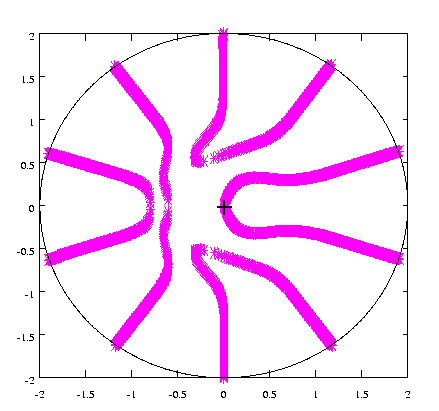
Below is an interesting evolution of stripes along a closed antiferromagnetic chain into a periodic structure via a series of domain wall creations.
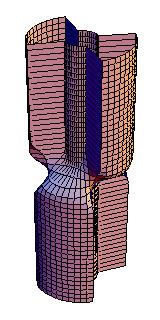
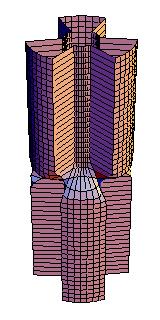
On magnetic cylinders these solutions correspond to fascinating domain walls. Below are a few examples:
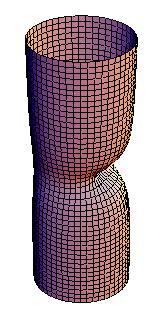
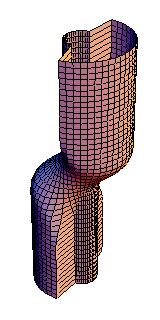
I have also been toying with the idea to apply my results (and others') on spin chains to ferromagnetic and antiferromagnetic polymers, but this will have to wait until the right collaborator comes along.
Past interests
(Some of these are still lingering, with semi-developed ideas lying all around. I would love to finish exploring some of those ideas but am defeated by lack of time and resources. Assistance would be quite welcome.)- Protein dynamics -
A slowly progressing project with M. Schwartz and Y. Navot has resulted so far in a rather efficient code for motion of a protein-like curve in a fluid. We are very optimistic that we can revolutionise the field by producing a code that will effortlessly simulate the folding of proteins into their correct structure. A slightly less ambitious target is to construct a good model for the dynamics of biological molecules in solutions. Such a model is very useful in many applications for, eg., the mobility of DNA molecules in electrophoresis, the drag mechanisms in low concentrations of polymer and the effects on viscosity. - fracture and crack propagation -
Slow cracking 1 2 3, fast cracking 1, and the rough surfaces that emerge 1 2. (past collaborations included B. L. Holian, R. C. Ball, P. Gumbsch, and a few others). - Characterization of hierarchical and fractal patterns beyond simple scaling -
Most hierarchical and fractal structures are characterized by their so-called fractal dimension, aka the scaling index. Yet, many structures with very close or even identical fractal dimension look completely different. This direction consists of methods to characterise such differences systematically (in part with Robin C. Ball, Benoit B. Mandelbrot and S. Torquato). - A first-principles statistical theory for evolving interfaces -
After studying to death the model of diffusion-limited-aggregation I discovered that one can actually apply statistical mechanical tools on the problem because there is an underlying Hamiltonian to the mathematical problem. Progress in this direction has been put aside for lack of time and a sufficiently enthusiastic collaborator/student. (partly with Robin C. Ball). - Properties of strongly nonlinear and inhomogeneous/textured media -
An old flame that is still silently burning. I have looked into quite a few problems involving such systems. Many of these involvde finding the macroscopic properties of media that respond in a strongly nonlinear fashion to an applied field, unlike the usual linear responses we learn in kindergarten, such as Ohm's law, a linear dielectric response to an electric field, or a linear stress-strain relation. I have then gone on to analyse what happens if such media are also geometrically disordered, namely, their constitutive properties vary significantly from point to point. Many of the results that I have obtained have been used by later researchers in the field but some have not, and there is still a great deal of exciting gems to mine, both in the theoretical and applied directions. - Electromagnetic waves in strongly nonlinear media -
 email me